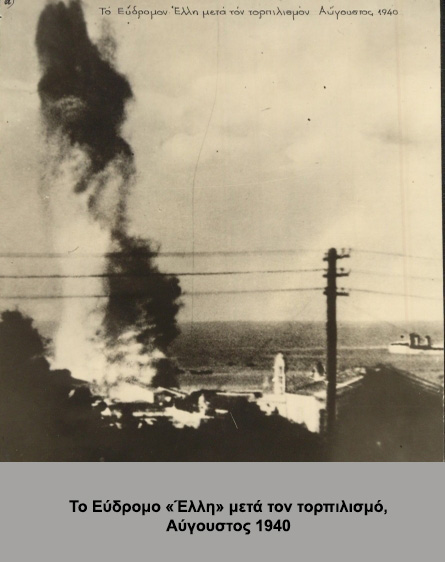
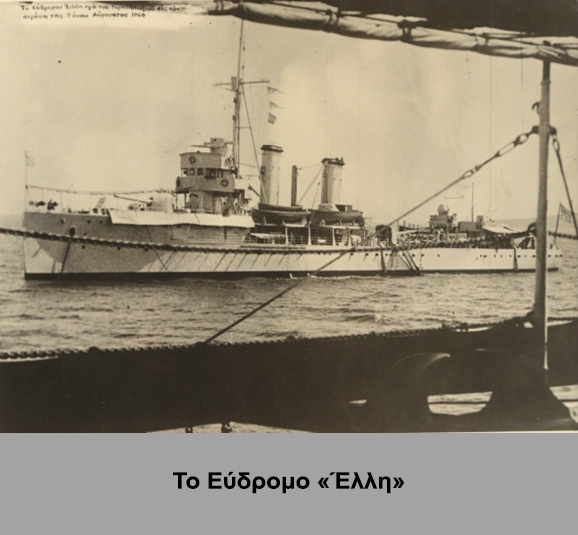
In June 1940, during World War II, Italy was an Axis power. Dictator Benito Mussolini wanted to revive the greatness of the Roman Empire. After conquering Libya, Ethiopia and Albania, the next target was Greece. The movement of powerful Italian forces towards the Greek borders in mid-August revealed his intentions, which he began to realise by conducting small-scale offensives on Greek ports and ships, culminating with the torpedoing of the “Elli”.
At 06:30 on 12 July, three Italian bombers attacked the Hellenic Navy auxiliary ship “Orion”, of the lighthouse service, while it was refuelling the Gramvousa lighthouse in the Gulf of Kissamos in western Crete. The same aircraft then attacked the destroyer “Hydra”, which had been ordered to rush to the assistance of the aforementioned vessel.
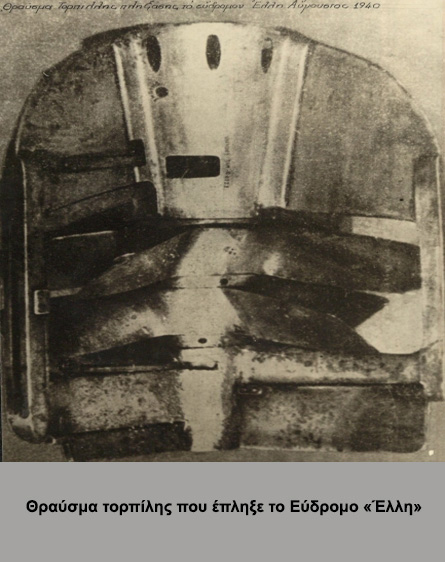
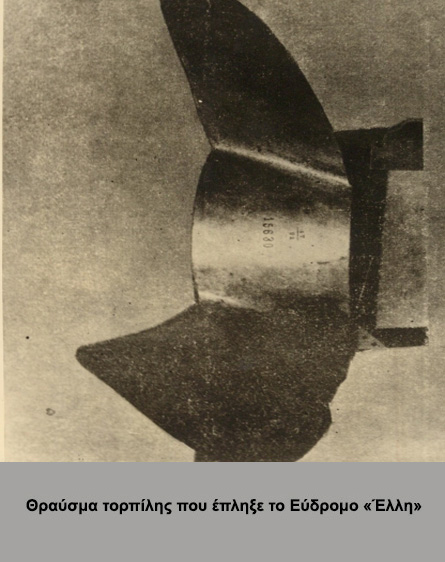
At 06:50 on 30 July, an Italian aircraft, coming from the Dodecanese and flying over the Gulf of Corinth, dropped four bombs on the Greek destroyers “King George” and “Queen Olga”, as well as on two submarines, which were in the port of Nafpaktos. The chemical analysis of fragments of the above bombs proved that they belonged to the same type of bombs with which the destroyer “Hydra” was attacked on 12 July 1940.
The order to torpedo the “Elli” was given by the Italian Commander of the Dodecanese, Cesare Maria de Vecchi, a leading figure in the Fascist Party of Italy and it must have been also known to the Italian dictator Mussolini. The Italian submarine “Delfino” commanded by Lieutenant Commander Giuseppe Aicardi set out from the naval base in Partheni, Leros, on the evening of 14 August, with a mission to attack enemy ships in Tinos and Syros and then to block the Corinth Canal. In the early hours of 15 August, the Italian submarine was underwater near the port of Tinos, with the intention of torpedoing the passenger ships “Elsa” and “Esperos”, carrying pilgrims, considered to be troop transporters by the Italians. Then the cruiser “Elli” arrived, sailing to Tinos for the celebration of the Feast of the Assumption.
It was a warship of the Hellenic Navy’s fleet. It was named after the Battle of Elli, which had taken place during the First Balkan War. The cruisers were warships of various sizes, of high speed and lighter weaponry in relation to battleships, which they gradually outplaced.
On 15 August, the aforementioned ship, with 2.115 tons displacement and a crew of 232 men, while at the Tinos bay, came under a surprise attack with torpedoes and at 0945 of the same day it sank, incurring the losses of 8 dead and 26 wounded from its crew.
“To maintain the Greek morale and the religious faith intact, the Greek Prime Minister ordered, despite the sinking of the cruiser, to not call off the litany, which was indeed officiated devoutly and with the whole populace present”.
This criminal Italian act deeply aggrieved the whole of Greece and aroused the sentiments of patriotism, honour and dignity, while at the same time it heightened the hatred against the criminals, who selected a great day of celebration for Christendom, to carry out their unholy act. At the same time, the torpedoing aroused negative sentiments to the global Press, which stigmatised the act. Even German newspapers expressed their sympathy towards Greece. The Italian government was worried because of the unfavourable impact in world public opinion and tried to alleviate its position, seeking to present the torpedoing of “Elli” as the work of England, which was supposedly trying to cause a commotion in the Balkans and poison the Greek-Italian relations.
#ΕλληνικόςΣτρατός, #HellenicArmys