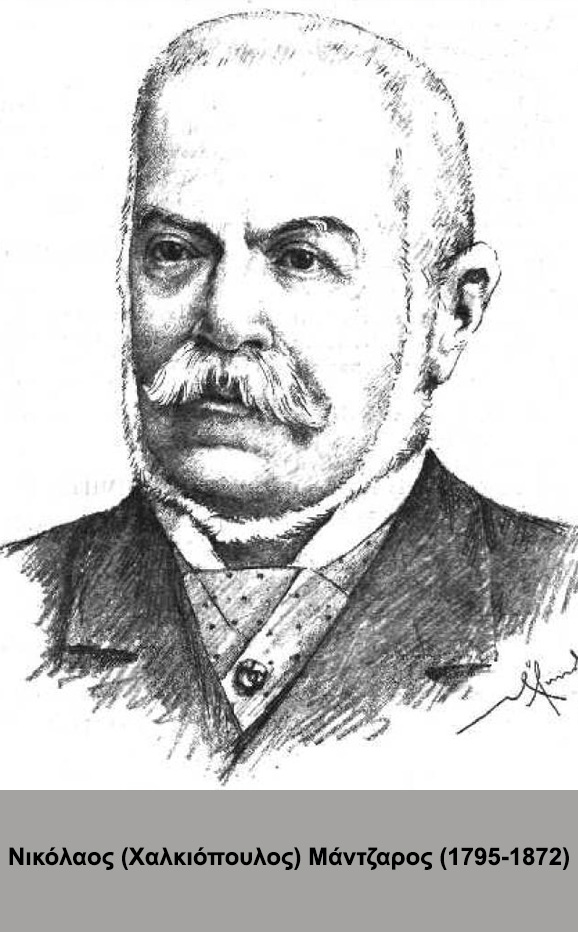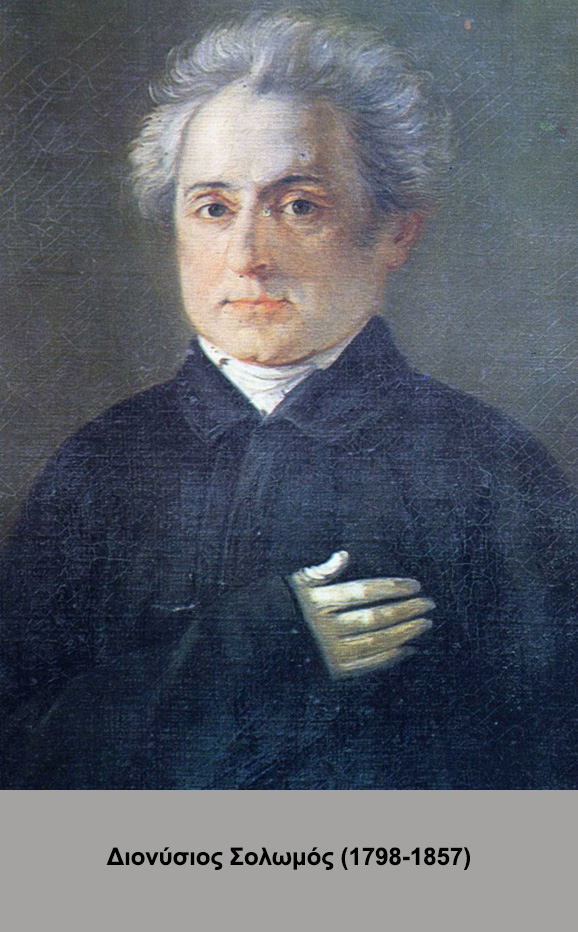
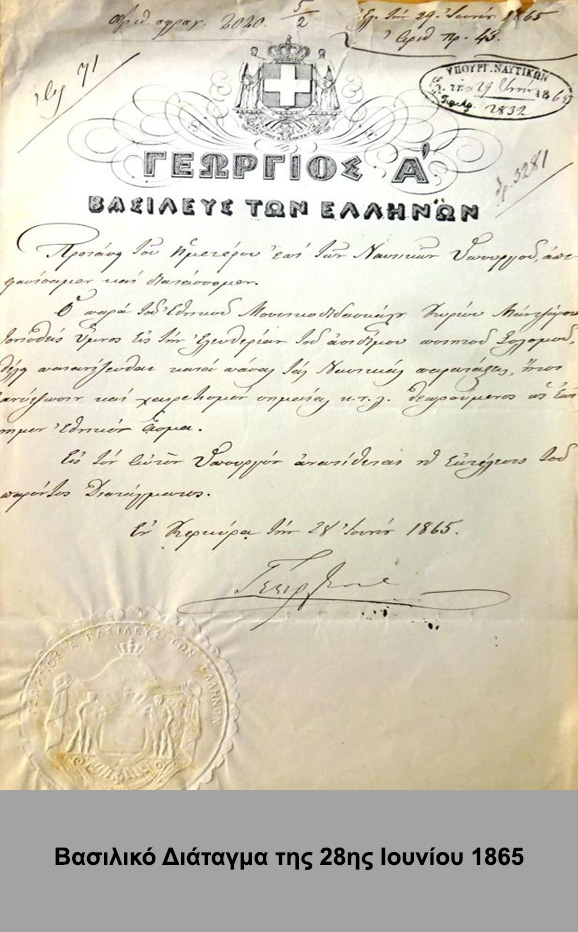
The establishment of the National Anthem of Greece in 1865 concerns the official adoption of the poem “Hymn to Liberty” by Dionysios Solomos (1798-1857), with music composed by the music educator Nikolaos (Halkiopoulos) Mantzaros (1795-1872).
In May 1823, when Dionysios Solomos, at just the age of 25, saw from Zakynthos the unfair struggle of the citizens of the town of Mesologi against the Ottomans, wrote in a short time the “Hymn to Liberty”. The “Hymn” consists of 158 quatrain stanzas with eight and seven syllables of rhyming lines. Solomos was dreaming of the Nation’s freedom and aimed at raising the morale of the fighters. The friend and teacher of the poet, Spyridon Trikoupis, when he travelled from Zakynthos to Roumeli, took a copy of the “Hymn” to give it to the poet Lord Byron. However, before reaching Mesologi, the great philhellene had passed away.
In 1825, with the contribution of Trikoupis, the “Hymn” was printed in the printing-office of D. Menestheas and with the help of Korais, it was published in volume B of the “Δημοτικών Τραγουδιών της Νεότερης Ελλάδας (Folk Songs of Modern Greece)” and after that it was distributed across the rebelled Greece. It was translated in many languages, inflaming the world public opinion and especially the intellectual world, from Hugo to Lamartine and Goethe. The latter called Dionysios Solomos the “Byron of the East”.
After the acquaintance of Mantzaros with Solomos, his main concern was the musical version of the “Hymn to Liberty” and other poems of his.
Mantzaros set the “Hymn” to music in three forms and three periods. The first period between 1828-1830, the second (unpublished) finished in 1844 and the third in 1861, urged by the Minister of Military Affairs at the time.
On 4 August 1865, the “Hymn to Liberty” was officially established as the National Anthem by King George A.
#ΕλληνικόςΣτρατός, #HellenicArmy