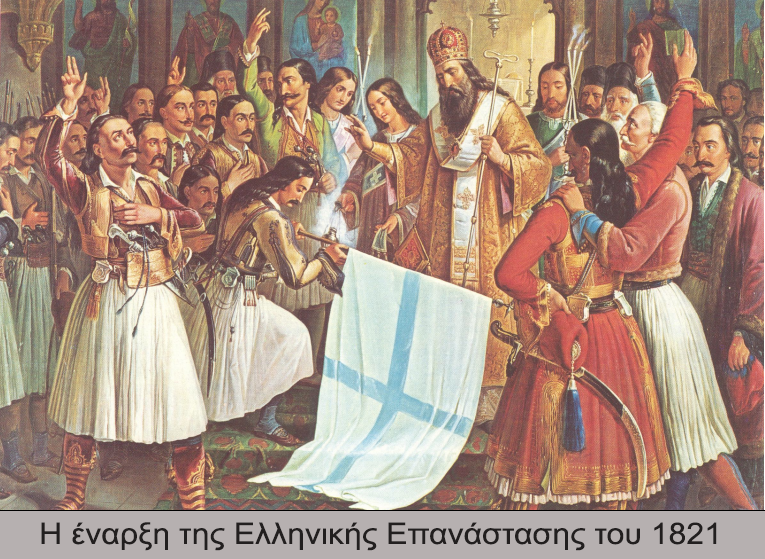

The revolt in Roumeli started in March of 1821. Among the most important clashes with the Ottoman army were the Battle of Alamana, where Athanasios Diakos was brutally killed, and the Battle of Gravia Inn, where Odysseas Androutsos distinguished himself.
In Roumeli, the conditions were not favourable for a revolt, since it was sparsely inhabited, especially in the west, and local notables had no great political experience. Furthermore, there were large Ottoman populations and troops in Euboea and Lamia, while in nearby Epirus, the capable Hurshid Pasha had campaigned against Ali Pasha of Yanina. These disadvantages were offset by the presence of famous klephts and armatoles in the area, resulting in better coordination for the rebels.
West Roumeli also revolted soon after. The Greeks managed to capture Vrahori (Agrinio), Aetoliko, and Mesolonghi. The Phanariot politician Alexandros Mavrokordatos soon arrived there to help with the war.
To deal with the revolt, Hurshid Pasha sent from Yanina Köse Mehmed Pasha and Omer Vrioni Pasha. The large Ottoman force was expected in Iraklia and the bridges of Gorgopotamos and Alamana by the chieftains Panourgias, Ioannis Dyovouniotis, and Athanasios Diakos. On 23 April 1821, the Turks drove away the defenders of the first two positions, seriously wounding Panourgias and killing Isaias, Bishop of Salona (Amfissa). Then, they united to attack the defenders of Alamana.
After fierce fighting, the Greek forces withdrew to Mount Kallidromo to a hill where the the leader of the East Roumeli rebels had his headquarters. Although Diakos was notified to abandon his position, he continued to fight. However, he was wounded and captured. Appreciating his bravery, Omer Vrioni offered to spare his life if he joined his army. Diakos refused and was brutally killed.
The Turks tied him up tightly and placed him almost upright against a tree. Halil Bey ordered a fire to be made to roast him alive. After hours of torture, the chieftain died on 24 April 1821.
The sacrifice of the young chieftain showed that the Greek War of Independence of 1821 was not a small revolt, but rather a decisive struggle to break the Ottoman yoke. Furthermore, it inspired the Greek rebels, who avenged his death during the successful Battle of Gravia Inn on 8 May 1821.
The last words of Athanasios Diakos will remain forever in our memory and echo as a symbol of patriotism through the ages. This was his reply to Omer Vrioni: “I was born a Greek and I will die a Greek”. And, as he was dying, he was heard singing “Look at the time Charon chose to take me, now that branches are flowering, now that the earth sends forth grass”.
#ΕλληνικόςΣτρατός, #HellenicArmy